

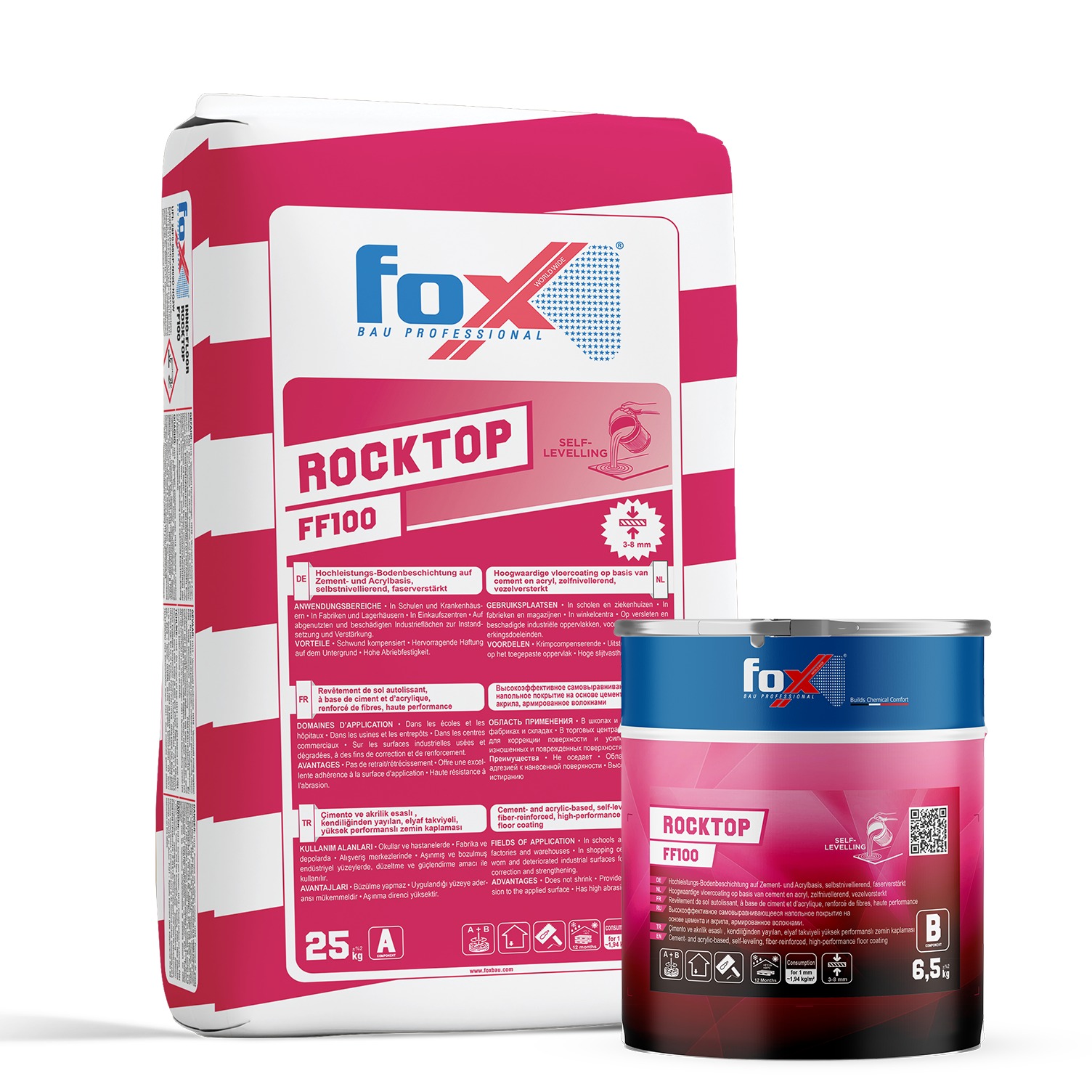
FOX ROCKTOP FF100 is a cement and acrylic-based, two-component, fibre-reinforced, self-levelling, high-strength and flexible industrial floor coating applicable at thicknesses of 3–8 mm. It provides excellent abrasion resistance and long-lasting protection in high-traffic areas such as schools, hospitals, factories, car parks and terraces.
Colour Palette
Packaging
31.5 kg
Product Description
FOX ROCKTOP FF100 is a cement and acrylic-based, two-component, fibre-reinforced, self-levelling, high-strength and flexible industrial floor coating applicable at thicknesses of 3–8 mm. Component A consists of special cement and fibre-reinforced mineral filler, while Component B is a copolymer acrylic dispersion. Thanks to its non-shrink structure and excellent adhesion, the product can be used with confidence for levelling and strengthening worn and deteriorated industrial surfaces. A compressive strength of ≥23 N/mm² and a bond strength of ≥2 N/mm² are achieved at 28 days. Its ability to accommodate floor stresses caused by temperature differentials also makes it resistant to freeze-thaw effects.
Key Benefits
- With a wide application thickness range of 3–8 mm, it addresses different floor levelling needs with a single product.
- Its self-levelling structure shortens application time and reduces labour costs.
- Its non-shrink formula minimises the risk of cracking and delamination.
- High bond strength (≥2 N/mm²) ensures permanent adhesion to the substrate, eliminating layer separation issues.
- Its resistance to freeze-thaw effects and mechanical loads offers long service life in open car parks and terraces.
- Enables rapid return to service in operational facilities; overcoating is possible after 12 hours for applications ≤3 mm.
Advantages
- Provides excellent strength at a maximum thickness of 8 mm.
- The fastest and easiest solution in operational facilities.
- Does not shrink.
- Excellent adhesion to the applied surface.
- Accommodates floor stresses caused by temperature differentials without being affected.
- Dust-free, robust and long-lasting.
- Resistant to mechanical loads.
- Resistant to freeze-thaw effects.
- High abrasion resistance.
- Self-levelling and self-smoothing.
Usage Areas
- In schools and hospitals
- In factories and warehouses
- In shopping centres
- In open and covered car parks
- In petrol stations
- On balconies and terraces
- On worn and deteriorated industrial surfaces, for levelling and strengthening purposes
Application Steps
- 1
Surface Preparation
The concrete substrates to be coated must be treated with abrasive equipment such as shot blasting, milling or diamond grinding to remove the cement laitance and open the pores. Weak concrete fragments must be removed from the surface, and small voids and holes must be fully opened. The resulting dust must be cleaned with an industrial vacuum. INNO-CRETE repair mortars should be used for substrate repair and filling of voids. The substrate compressive strength must be at least 25 N/mm², tensile strength at least 1.5 N/mm², moisture content maximum 4%, and substrate temperature minimum +8°C; care must be taken to ensure the substrate temperature is at least +3°C above the dew point.
- 2
Priming
The substrate must be primed to improve adhesion, reduce air bubbles and prevent the mixing liquid from being absorbed by the substrate. Depending on the substrate structure, an appropriate primer from the FOX EPOTHANE® series is applied; while the material is still wet, silica sand 40–45 AFS (0.2–0.5 mm) is broadcast onto the surface and left for a minimum of 12 hours (24 hours depending on weather conditions). After scraping off the excess from the surface, loose sand is cleaned with an industrial vacuum. FOX UNIPRIMER FL555 primer is then applied diluted 1:1 with water, or FOX PRIMERA® FL220 primer is applied by brush or roller.
- 3
Mixing
Component B is poured into a clean mixing bucket. Component A is slowly added to Component B and mixed for 3–4 minutes using an electric mixer (400–600 rpm) with a suitable mixing paddle until a homogeneous mixture is obtained. After waiting approximately 2 minutes, mix for a further 1 minute before use.
- 4
Coating Application
The prepared FOX ROCKTOP FF100 is poured onto the surface and applied at the desired thickness using a notched trowel or screed trowel. A spiked roller must be applied shortly after spreading to eliminate any air bubbles that form. If the spiked roller application is delayed, roller marks may remain on the surface; therefore the application must be completed quickly. A monolithic application is recommended for a smooth surface.
- 5
Cleaning of Tools and Equipment
Tools and equipment used after application must be cleaned with water. Once FOX ROCKTOP FF100 has hardened, it can only be removed from the surface mechanically.
Critical
Application must not be carried out if the ambient and surface temperature is below +5°C or above +30°C; suitable temperatures must be awaited.
Critical
The freshly applied product must be protected from sunlight and wind to prevent rapid drying.
Critical
Application must not be carried out in excessively hot, rainy or windy weather.
Important
Materials to be used on the application area should be brought to the site and stored 1–2 days in advance to allow them to acclimatise to ambient conditions.
Important
In applications carried out in extremely cold weather, the ambient and substrate temperature should be raised using heaters, and materials should be conditioned at +20°C – +25°C before use.
Critical
For the material to complete its cure, the ambient and substrate temperature must not fall below the permitted minimum temperature.
Important
After mixing, the material should be allowed to rest and then mixed again.
Critical
FOX ROCKTOP FF100 Component B freezes at temperatures below 0°C; the product must be stored in a dry and cool environment (between +5°C and +30°C), protected from sunlight and frost.
Important
Opened packaging must be resealed and consumed within 1 week.
Critical
Approaching storage and application areas with open flames is dangerous; areas must be ventilated.
Critical
Work clothing, protective gloves, goggles and a mask must be worn during application. Contact with skin and eyes must be avoided; in case of contact, wash thoroughly with plenty of water and soap. In case of ingestion, seek medical attention immediately.
Important
Food and beverages must not be brought into application areas. Store out of reach of children.
Information
The working and reaction times of cement-based systems are affected by ambient and substrate temperature and relative humidity. Reaction slows at low temperatures; high temperatures accelerate the reaction.
Related Products
Similar products to this item