

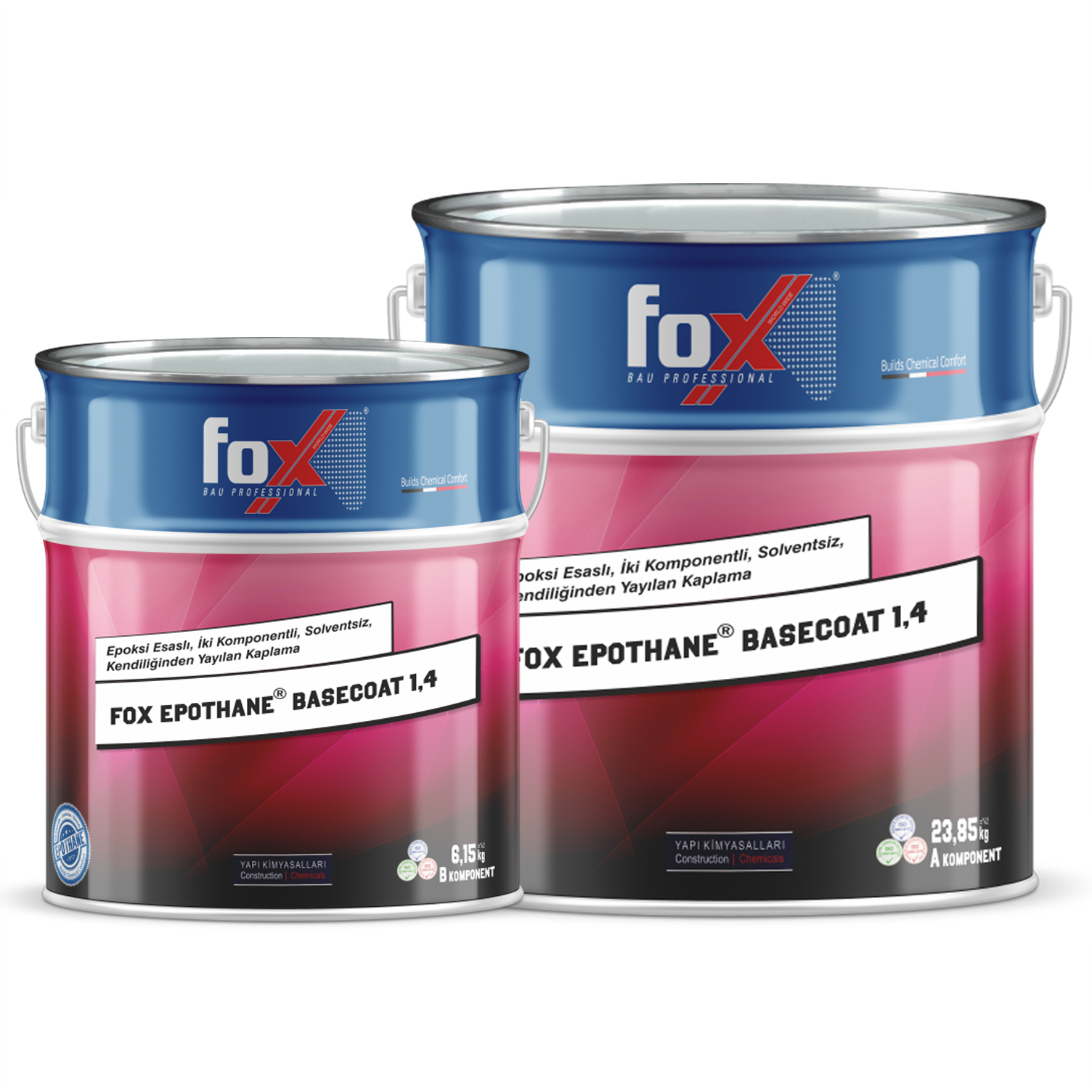
FOX EPOTHANE® BASECOAT 1.4 is a two-component, epoxy resin-based, high chemical resistance, solvent-free, self-levelling coloured industrial floor coating. It has a wide range of applications, from industrial floors under heavy traffic loads to hospitals and laboratories requiring hygiene.
Colour Palette
RAL Colours
Packaging
30 kg
Product Description
FOX EPOTHANE® BASECOAT 1.4 is a two-component, epoxy resin-based, high chemical resistance, solvent-free, self-levelling coloured industrial floor coating. The product is supplied as a 30 kg set consisting of components A and B. The recommended application thickness is between 1.5 mm and 3.0 mm. Shore D hardness reaches 85 after 7 days; compressive strength is ≥65 N/mm² and adhesion strength to concrete is ≥1.5 N/mm² as tested. Thanks to 100% solid content, there is no volatile organic compound emission. The pot life at +23°C is 30–35 minutes. The product must be applied to surfaces prepared with a suitable FOX EPOTHANE® series primer prior to application.
Advantages
- Easy to apply.
- Can be highly filled with aggregates.
- High chemical and mechanical resistance.
- High abrasion resistance.
- Easy to maintain and clean.
- Flowable consistency.
- Provides hygienic environments.
- Has a structure that does not allow microbial growth.
- Liquid-tight.
- Achieves a glossy topcoat finish.
- High adhesion strength.
Usage Areas
- Areas exposed to heavy/medium/light traffic loads
- Areas requiring chemical and mechanical resistance
- Warehouses
- Production areas
- Aircraft hangars
- Car parks
- Garages
- Airports
- Galleries
- Shopping centres
- Supermarkets
- Shops and showrooms
- Machine rooms
- Hotels
- Hospitals and nursing homes
- Clinics
- Schools and nurseries
- Chemical and pharmaceutical industry
- Laboratories
- Areas where hygiene is required
Application Steps
- 1
Surface Preparation
The concrete substrate to be coated must be prepared using abrasive equipment (shot blasting, milling, diamond grinding, etc.) to remove the cement laitance and achieve an open-porous surface. Weak concrete sections must be removed, and small voids and holes must be fully opened. The resulting dust must be cleaned with an industrial vacuum. For substrate repairs and filling of voids, a mortar prepared by mixing 60–70 AFS (0.1–0.3 mm) quartz sand with FOX EPOTHANE® PRIMER series primer should be used.
- 2
Surface Quality Control
The concrete compressive strength must be at least 25 N/mm², tensile strength at least 1.5 N/mm², moisture content a maximum of 4%, and floor temperature a minimum of +10°C. Care must be taken to ensure the floor temperature is at least +3°C above the dew point. The substrate must be clean, dry and free from foreign matter (dirt, oil, grease, coatings, surface curing compounds, etc.).
- 3
Priming
Surfaces to receive FOX EPOTHANE® BASECOAT 1.4 must be primed in advance with a suitable FOX EPOTHANE® series primer. Ensure that the floor temperature is a minimum of +5°C. FOX EPOTHANE® BASECOAT 1.4 must be applied within the open time of the primer.
- 4
Mixing
Ensure that the product temperatures are between +15°C and +25°C. First, component A is homogenised using an electric mixer (300–400 rpm). After component B has been fully added to component A, mix for at least 3 minutes. Then add the required amount of 60–70 AFS (0.1–0.3 mm) silica sand and mix for a further 2 minutes. Avoid over-mixing to minimise air entrainment.
- 5
Coating Application
FOX EPOTHANE® BASECOAT 1.4 is poured onto the surface and spread evenly with a notched trowel. Once the coating reaches the appropriate consistency, a spike roller is applied to release air. If the spike roller application is delayed, marks may remain on the surface. If the floor surface is homogeneous and void-free, a spike roller may not be necessary.
- 6
Tool and Equipment Cleaning
Tools and equipment used must be cleaned immediately after application with solvent or epoxy thinner. Once FOX EPOTHANE® BASECOAT 1.4 has cured, it can only be removed from the surface by mechanical means.
Critical
The surface temperature during application must be a minimum of +5°C and a maximum of +30°C.
Critical
The ambient temperature must be a minimum of +5°C and a maximum of +30°C.
Critical
The material temperature must be a minimum of +5°C and a maximum of +30°C.
Critical
The surface moisture content must be below 4%. Test method: CM measurement or oven-drying method.
Critical
There must be no rising moisture according to ASTM (polyethylene sheet test).
Important
Relative air humidity must be a maximum of 80%.
Critical
The floor temperature must be at least +5°C above the dew point. Pay attention to dew formation and condensation.
Critical
After application is complete, the coating must be protected from direct water contact for at least 24 hours. In case of water contact, softening and blistering will occur; the coating must be completely removed and reapplied.
Critical
Concrete surfaces to be coated with epoxy/polyurethane must be at least 3 weeks old prior to application.
Critical
Mixing must be carried out using an electric mixer at 300–400 rpm with the specified epoxy/polyurethane resin mixing paddle. Otherwise, air bubbles will form on the coating.
Important
Before starting mixing, ensure that the product temperatures are between +15°C and +25°C.
Important
Materials to be used should be brought to the application site 1–2 days in advance and allowed to acclimatise to ambient conditions.
Important
Rain, dust, wind, animals and insects must be prevented from entering the building while the coating is still fresh.
Important
The product should be stored at room temperature, away from direct sunlight, between +5°C and +30°C. It must be kept in its original unopened packaging, in a cool and dry environment, protected from frost.
Critical
Approaching storage and application areas with open flames is dangerous. Areas must be ventilated.
Critical
Work clothing, protective gloves, goggles and a mask must be worn during application. In case of contact with skin or eyes, wash thoroughly with plenty of water and soap; if swallowed, seek medical attention immediately.
Information
The product does not contain volatile organic compounds (VOC/solvent).
Information
Consumption figures are given for ideal conditions assuming an ambient and surface temperature of 20°C. It should be noted that consumption will increase on uneven surfaces and in cold weather conditions.
Important
The chemical resistance table was prepared at room temperature. Elevated temperatures and/or mixtures of chemicals may affect chemical resistance. If the surface is exposed to chemicals, it must be cleaned within a maximum of 1 hour.
Related Products
Similar products to this item