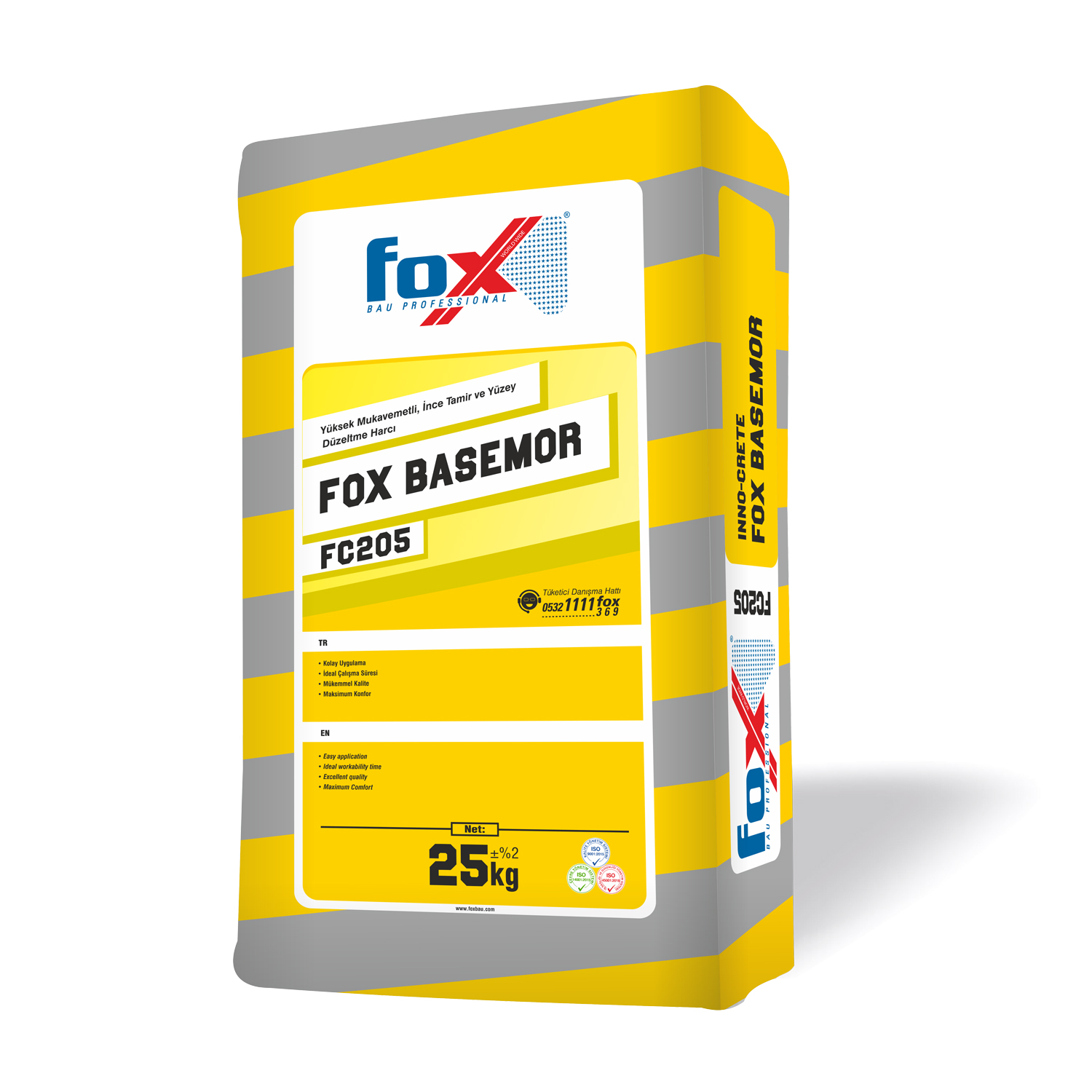


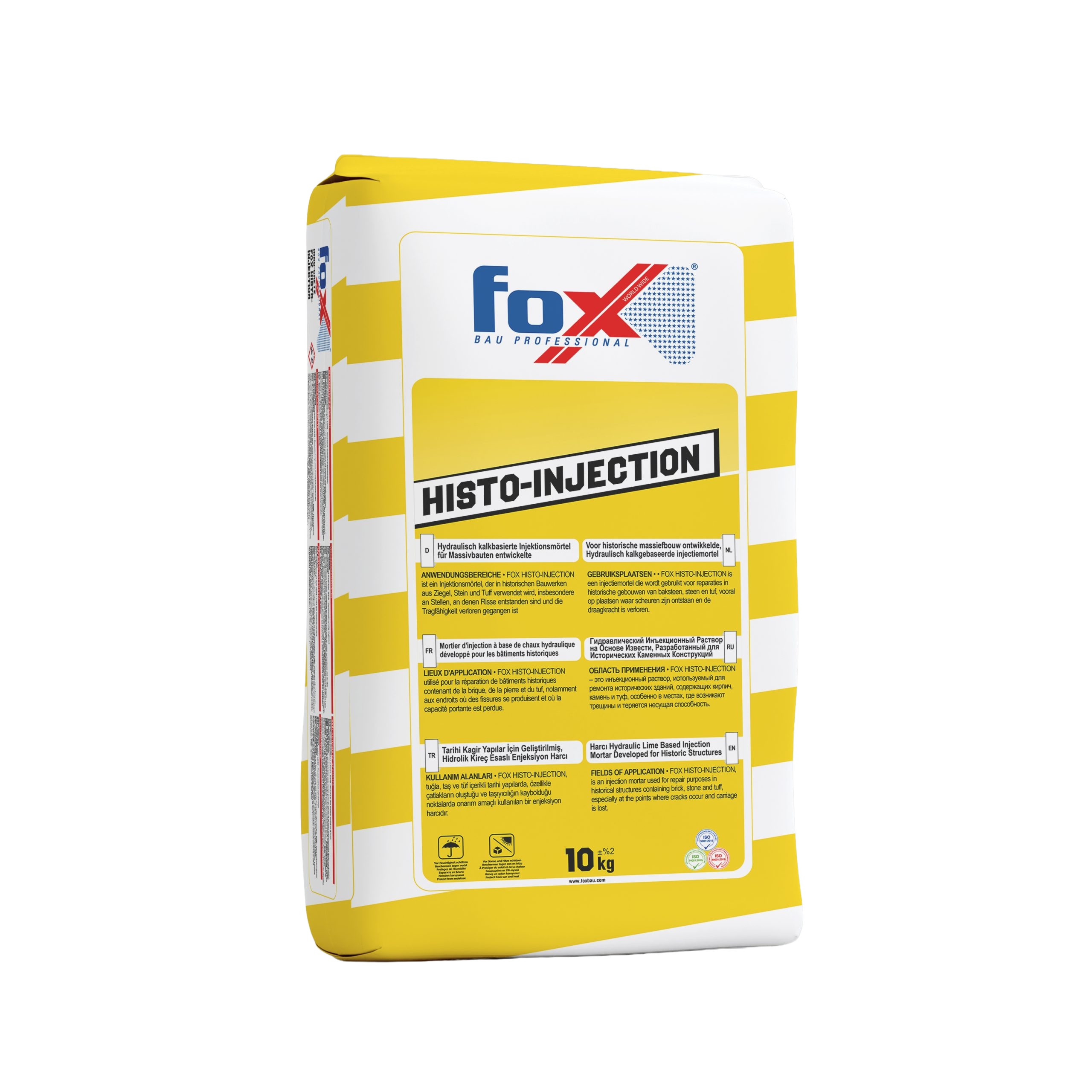
FOX HISTO-INJECTION is an injection grout containing pozzolanic natural hydraulic lime and micronised carbonates, used for the structural repair of historic masonry building components such as brick, stone and tuff. It has a wide range of applications, from crack repair to foundation strengthening.
Colour Palette
Packaging
10 kg
Product Description
FOX HISTO-INJECTION is an injection grout containing pozzolanic natural hydraulic lime and micronised carbonate, used for the structural repair of masonry building components. It has been developed for use in historic structures built with brick, stone and tuff — particularly at points where cracks have formed and load-bearing capacity has been lost. It can be used even in sulphate-bearing environments and does not cause adverse chemical interactions with original building materials. Thanks to its next-generation polycarboxylic ether-based superplasticisers, it can be easily injected using low-pressure pumps, syringes or fine needles. Its 28-day compressive strength exceeds 14 N/mm² and its particle size ranges from 0.1–30 μm (D₈₅ = 15 μm). 0.30 litres of water is used per 1 kg of powder; 1.50 kg of powder is required to obtain 1 litre of grout.
Key Benefits
- Effectively fills cracks and voids in historic brick, stone and tuff structures, restoring structural integrity.
- Can be safely applied in sulphate-bearing environments without adverse chemical reactions.
- Injection can be carried out without pre-wetting the surface, preventing water from reaching and damaging frescoes.
- Easily injectable using low-pressure pumps and fine needles, increasing application efficiency.
- Its controlled expansion prevents harmful stresses from developing in the repaired structure.
- Achieves excellent compatibility with original building materials without impairing vapour and moisture permeability.
Advantages
- Can be used even in sulphate-bearing environments.
- Does not cause adverse chemical interactions with original building materials or with different materials used during and after the restoration process.
- The superior hydraulic nature of the binder allows the injection grout to penetrate deeply into the structure. With its moderate modulus of elasticity, it is ideal for filling small and large voids even in cases of load-bearing problems caused by excessive moisture in the original material.
- The injection material used in wall repair achieves excellent compatibility with brick, stone and tuff without impairing the wall's vapour and moisture permeability.
- Provides controlled expansion that prevents plastic shrinkage without causing harmful stresses in the structure being repaired.
- Thanks to the natural water-retaining agents it contains, injection can be carried out without pre-wetting the surface, preventing water from separating from the injection grout and reaching and damaging frescoes.
- With its next-generation polycarboxylic ether-based superplasticisers, it can be easily and effectively injected using low-pressure pumps, syringes or fine needles.
- Contains no admixtures or soluble salts (alkalis, sulphates, chlorides or nitrates) and does not deteriorate over time.
Usage Areas
- In walls located in sulphate-bearing environments
- In historic masonry domes and vaults
- For filling small and large structural voids
- For crack repair
- As an injection material in foundations
Application Steps
- 1
Surface Preparation
The render on the surface must be removed so that the entire crack plane can be identified. The surface to be treated must be freed from dust, grease and construction debris, and damaged or loose parts must be removed. If there is water seepage on the surface, it must be drained or sealed with a suitable plugging mortar.
- 2
Application for Cracks Between 1–5 mm
Holes are drilled in a staggered pattern from both sides of the crack plane at intervals of approximately 30–50 cm, at an angle of approximately 45° to the crack plane and to a depth that passes through the crack. The holes are cleaned with compressed air and packers are fixed inside them. The areas around the packers and over the crack are coated with FOX EPOMORTAR FC 510 to ensure sealing. In dry conditions, water is first injected into the packers. Depending on ambient and weather conditions, injection begins no earlier than 24 hours later using an injection apparatus.
- 3
Application for Cracks Wider Than 5 mm
Pneumatic hoses are placed inside the crack at intervals of approximately 75–100 cm. Loose particles are removed with compressed air. The areas around the hoses and over the crack are coated with FOX EPOMORTAR FC 510 to ensure sealing. Depending on ambient and weather conditions, injection with FOX HISTO-INJECTION begins no earlier than 24 hours later using a suitable injection pump.
- 4
Mixing
0.30 litres of clean water is measured and placed into a mixing bucket. FOX HISTO-INJECTION powder is added slowly and mixed with a mixer at 400–600 rpm for 3–4 minutes until a homogeneous, lump-free mixture is obtained. After resting for approximately 4 minutes, mix for a further 30 seconds.
- 5
Injection
The prepared grout is injected into the crack using suitable injection equipment and apparatus.
- 6
Tool Cleaning
Tools and equipment used after application must be cleaned with water. Once FOX HISTO-INJECTION has hardened, it can only be removed from the surface by mechanical means.
Critical
During application, ambient and surface temperature must not fall below +5°C or exceed +35°C.
Critical
For the material to fully set, ambient and substrate temperature must not drop below the permitted minimum temperature.
Critical
Mixing must be carried out using suitable mechanical mixers. Hand mixing must not be used.
Critical
Depending on ambient and weather conditions, injection must not begin until at least 24 hours have elapsed, using a suitable injection apparatus.
Important
Materials to be used should be brought to the application site 1–2 days in advance and allowed to acclimatise to site conditions.
Important
Opened packaging must be resealed and consumed within 1 week.
Important
When stored correctly at room temperature, away from direct sunlight, between +5°C and +30°C, the shelf life is 12 months from the date of manufacture.
Important
Must be stored in its original unopened packaging, in a cool and dry environment, away from direct sunlight and protected from frost. For short-term storage, a maximum of 3 pallets may be stacked; for long-term storage, pallets must not be stacked.
Critical
Approaching storage and application areas with open flames is dangerous. Storage and application areas must be ventilated.
Important
During application, appropriate work clothing, protective gloves, goggles and a mask must be worn in accordance with occupational health and safety regulations.
Critical
During storage and application, contact with skin and eyes must be avoided; in case of contact, wash immediately with plenty of water and soap; if swallowed, seek medical attention immediately.
Important
Food and beverages must not be brought into application areas. Must be stored out of reach of children.
Information
The technical values above are given at +23°C and 50% relative humidity. Higher temperatures shorten the working time; lower temperatures extend it.